A Guide to Turkish Spices: The Essentials and How to Use Them
Published on
Turkish cooking doesn't rely on complicated spice blends. Compared to some neighboring cuisines, it tends to lean on a small set of bold, single-note spices, used with a fairly light hand — a pinch of sumac over grilled onions, a shower of pul biber over eggs, a careful measure of cumin in a meatball mix. Several of these spices are tied to specific growing regions of Turkey, and the difference between a good and a mediocre batch often comes down to where and how it was processed.
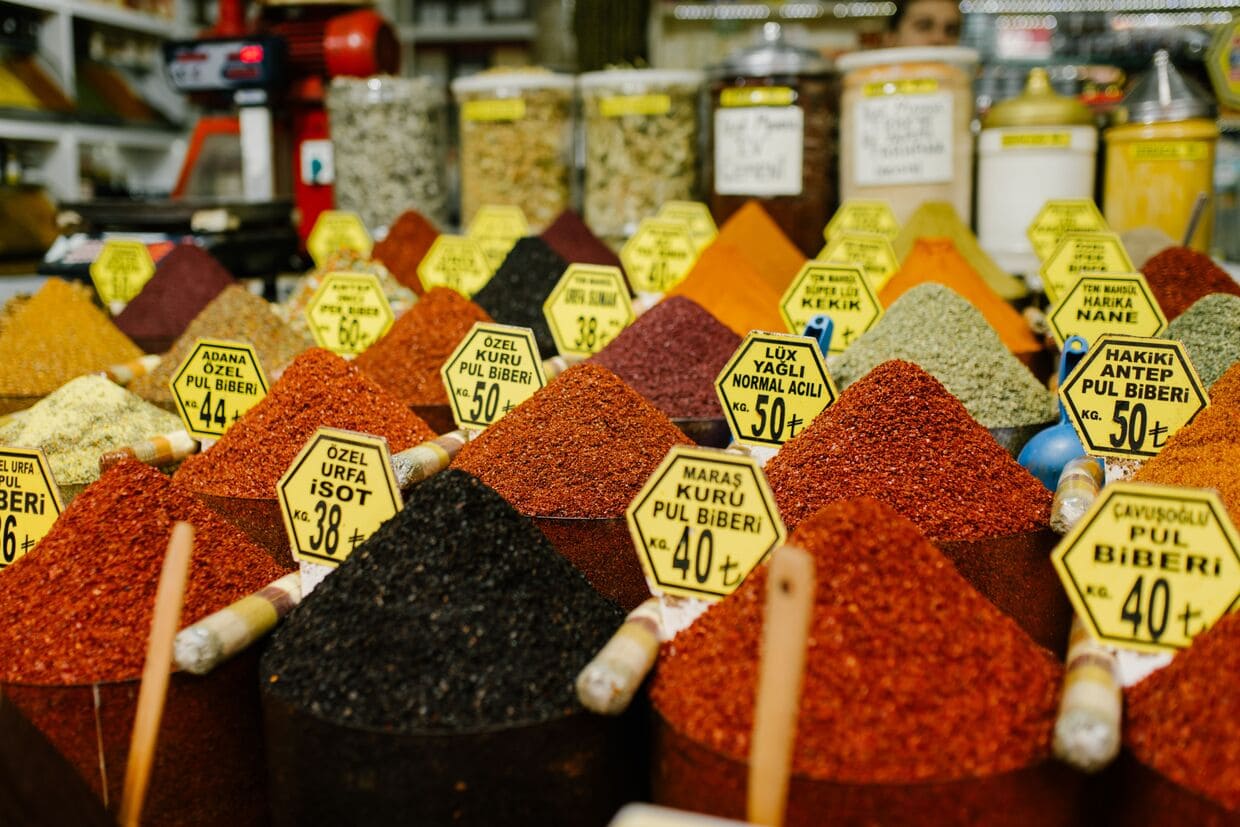
Pul Biber
Pul biber is the everyday red pepper flake of the Turkish table — coarse, oil-glossed flakes that range from mild to noticeably hot depending on the batch and region. It's often labeled "Aleppo-style" outside Turkey because of its resemblance to Aleppo pepper, though most of what's sold as pul biber today is grown and processed in Turkey, particularly around Kahramanmaraş.
Practical usage: Pul biber is a finishing spice as much as a cooking one. It's scattered over eggs, stirred into yogurt or olive oil for dipping bread, sprinkled on soups and lentil dishes, and worked into meat mixtures for köfte and kebabs. Because the heat is moderate, it can be used generously without overwhelming a dish.
Urfa Biber (Isot Pepper)
Urfa biber, also called isot pepper, is one of the most distinctive spices in Turkish cooking and arguably the most misunderstood outside the country. It comes from Şanlıurfa in southeastern Turkey, and what sets it apart isn't the chili variety itself but the processing: the peppers are sun-dried during the day and then wrapped tightly at night to "sweat," a cycle repeated over roughly one to several weeks. That alternating dry-and-sweat process — rather than smoking, despite how the flavor reads — is what turns the peppers a deep purplish-black and develops their signature complexity.
The result tastes almost nothing like a standard dried chili. Urfa biber is typically described as smoky and earthy, with a raisin-like sweetness, hints of tobacco and dark chocolate, and a mild tanginess from the tannins the drying process concentrates. Its heat builds slowly rather than hitting immediately, and it sits toward the milder end of medium — sources disagree on an exact Scoville figure, but it's consistently described as gentler and slower than pul biber or cayenne. Texturally, it's coarser and slightly moist compared to most dried chili flakes, since a small amount of oil is often worked in during grinding.
- Isot
- The local Turkish name for Urfa biber, used interchangeably with "Urfa biber" both inside and outside Turkey.
Practical usage: Urfa biber is central to dishes like çiğ köfte and lahmacun, but it's just as useful as a general finishing spice. Try it sprinkled over roasted vegetables, stirred into acılı ezme (a spicy Turkish tomato-pepper paste), worked into a dry rub or marinade for lamb or beef, or finished over eggs and hummus. Because its heat is restrained, it's forgiving to use generously — it adds smoke and depth more than it adds fire. It's worth noting that outside Turkey, pickled or fresh Urfa preparations are essentially unavailable; the dried, flaked form is what's exported.
Maraş Pepper
Closely related to pul biber and sometimes confused with it, Maraş pepper (Maraş biber) comes from the Kahramanmaraş region and has a brighter red color and slightly different heat profile than Urfa biber — closer to pul biber in intensity, but with its own regional character. In many recipes, pul biber and Maraş pepper are used interchangeably, though Turkish cooks often have a regional preference.
Practical usage: Use it the same way you'd use pul biber — as a finishing sprinkle for grilled meats, roasted vegetables, and dips.
Sumac
Sumac is made from the dried, ground berries of the sumac shrub and is one of the few Turkish spices that brings pure acidity rather than heat. Its flavor is tart, citrusy, and slightly fruity — often compared to a squeeze of lemon in powder form — and it adds a deep reddish-purple color wherever it's used.
Practical usage: Sumac is typically added at the end of cooking rather than during it, since its bright flavor fades with heat. It's classically sprinkled over grilled onions, tomato and onion salads (it's a defining ingredient in çoban salatası, Turkish shepherd's salad), grilled fish and meat, and yogurt-based dips. Think of it as a substitute for a squeeze of lemon whenever you want acidity without adding liquid.
Cumin (Kimyon)
Cumin is one of the backbone spices of Turkish savory cooking — warm, earthy, and slightly nutty, with a pronounced aroma. It's a defining flavor in köfte and kebab spice mixes, often paired with sumac and pul biber.
Practical usage: Ground cumin goes into meat and lentil dishes, stews, and bread doughs. It's typically bloomed briefly in oil or mixed directly into ground meat before shaping, which helps release its aroma.
Dried Mint (Nane)
Dried mint is used far more than fresh mint in everyday Turkish cooking, and it has a more concentrated, slightly different character than fresh — earthier and less sweet. It's worth seeking out mint specifically labeled as spearmint rather than peppermint, since the latter has a sharper, more medicinal flavor that doesn't suit savory dishes.
Practical usage: Dried mint is stirred into lentil soups (particularly ezogelin soup), sprinkled over yogurt-based dishes like cacık, and used in stuffed vegetable fillings alongside rice and herbs.
Nigella Seeds (Çörek Otu)
Nigella seeds are small, matte-black seeds with a flavor often described as a cross between onion, black pepper, and oregano. They're not related to black sesame, which they're sometimes mistaken for by appearance.
Practical usage: Their most common role in Turkish kitchens is as a topping — scattered over simit (Turkish sesame-crusted bread rings), poğaça and other pastries, and white cheese, where their sharp aroma and crunch provide contrast rather than being cooked into a dish.
Warming spices: cinnamon, allspice, and cloves
Unlike in many Western kitchens, cinnamon, allspice (yenibahar), and cloves show up regularly in Turkish savory cooking, not just in desserts. Their warmth is used to round out meat dishes and rice pilafs, a habit that traces back to Ottoman palace cooking, where spices arriving through Ottoman trade routes became staples of both sweet and savory preparations.
Practical usage: A pinch of cinnamon or allspice is common in ground meat mixtures for köfte, in rice pilafs, and in slow-cooked stews, where it adds background depth rather than an overt "spiced" flavor. These spices are also core components of baharat, a warming spice blend (typically built from some combination of cinnamon, cloves, cumin, coriander, nutmeg, and black pepper) used across Turkish and wider Middle Eastern cooking as a meat rub or stew seasoning; the exact mix varies by region and household rather than following one fixed recipe.
What distinguishes Turkish spice use isn't complexity — it's precision. A handful of spices, several tied to specific regions and traditional processing methods, do most of the work, usually added toward the end of cooking so their character stays distinct rather than melting into a dish. Urfa biber is the clearest example of this: a spice defined entirely by how it's dried, not by heat, and one that rewards using generously precisely because it isn't trying to be fiery.