Hojicha Tea
Published on
Most Japanese green teas share a family resemblance: grassy, vegetal, a little bitter, and often high in caffeine. Hojicha is the exception — made from the same tea plant, but transformed by a single step in production that changes nearly everything about how it tastes and how it's used.
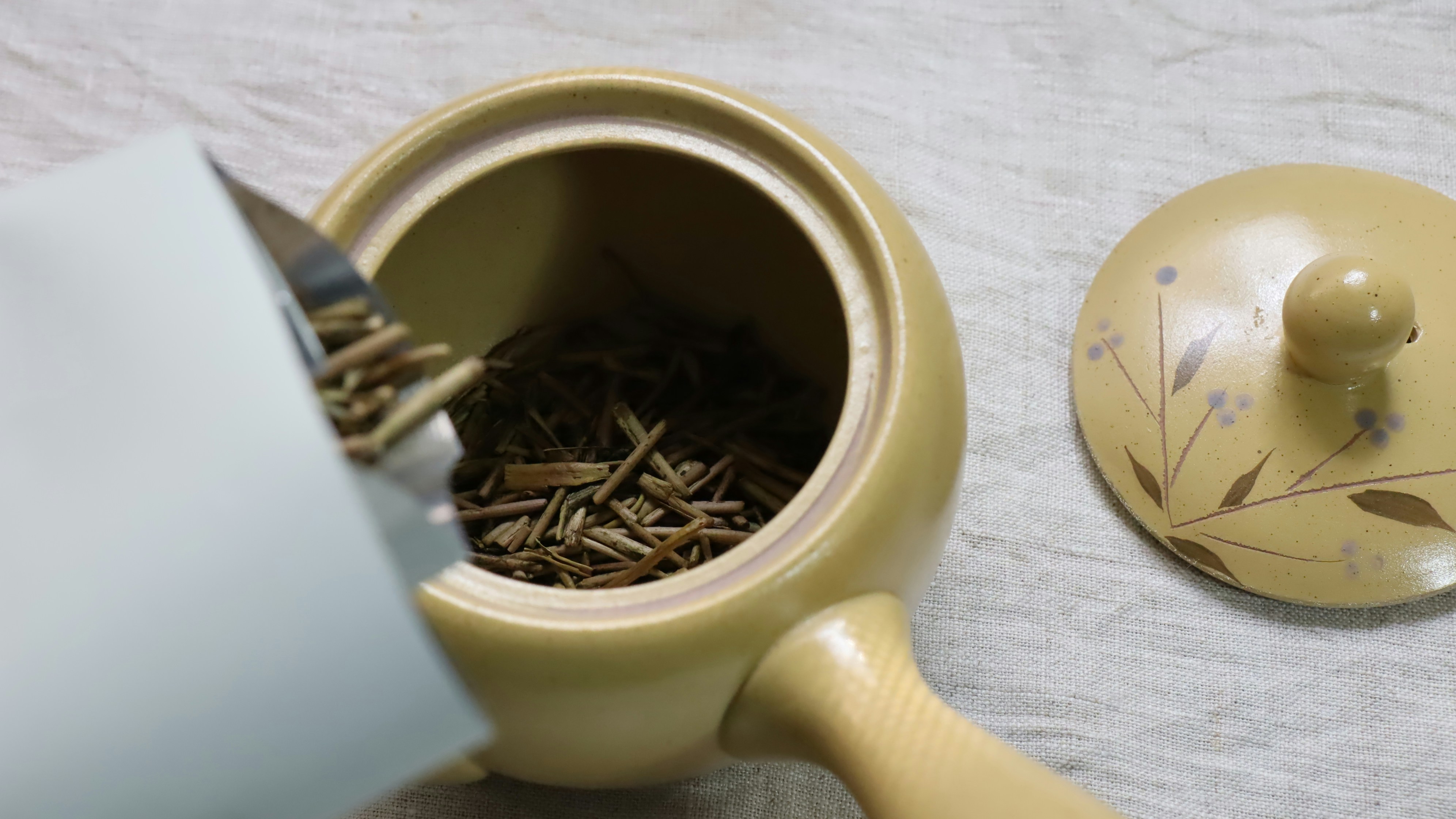
Where hojicha comes from
Hojicha is a relatively recent addition to Japan's tea culture. It's generally traced to Kyoto in the 1920s, when tea merchants were looking for a way to use up the parts of the harvest that didn't make the cut for premium tea — leftover leaves, stems, and stalks from bancha, sencha, or kukicha production. Rather than discard this lower-grade material, someone began roasting it over charcoal, and a new category of tea was born.
The economics mattered as much as the flavor. Because hojicha used material that would otherwise go to waste, it was cheap to produce, which helped it spread quickly across social classes and become a staple of everyday drinking rather than a specialty product.
What roasting actually does
The defining step is straightforward to describe, even if the chemistry behind it is more complex: green tea leaves are roasted in a porcelain pot over very high heat, commonly cited at around 200°C (390°F). That heat does three things simultaneously.
It changes the color. The leaves shift from green to a reddish-brown, and the brewed liquor takes on an amber to copper hue rather than green tea's typical pale green or yellow.
It reduces bitterness. Green tea's characteristic astringency comes largely from catechins, a group of tannin compounds. High-heat roasting breaks these down, which is why hojicha tastes notably smoother and less sharp than sencha or matcha, even before any milk or sugar is added.
It creates new flavor compounds. Roasting produces pyrazines, which is why hojicha's flavor profile reads as earthy, nutty, and slightly smoky, with notes people often describe as toasted caramel or cocoa, rather than "tea-like" in the way sencha is.
- Pyrazines
- A class of aromatic organic compounds produced by high-heat roasting. They're also responsible for the smell of roasted coffee, toasted nuts, and baked bread, which is part of why hojicha can read as "coffee-like" to a Western palate.
Caffeine content is also reduced by the roasting process, since much of it is lost to the heat, though the exact reduction varies by source and roasting method. The result is a tea with meaningfully less caffeine than standard green tea or matcha, though "low caffeine" should not be read as "no caffeine" — hojicha still contains some.
| Tea | Caffeine | Astringency | Flavor |
|---|---|---|---|
| Matcha | High | High | Grassy, vegetal, umami |
| Sencha | Moderate | Moderate | Grassy, slightly sweet |
| Hojicha | Low | Very low | Toasty, nutty, mildly sweet |
Why it's an everyday, all-hours tea
These characteristics shape how hojicha is actually consumed in Japan. Because it's low in astringency and caffeine, it functions as a casual, drink-anytime tea rather than a ceremonial or occasion-specific one. Its low caffeine content in particular makes it a common choice in the evening or after dinner, when a stronger tea would be more likely to interfere with sleep.
The same gentleness extends to who drinks it. Hojicha is widely considered easy on the stomach, and it's a common tea to serve to children, older adults, and hospital patients — groups for whom the astringency and caffeine load of other green teas can be less suitable.
Outside Japan, hojicha has been gaining ground as an alternative to coffee for people who want a deep, roasted flavor without coffee's caffeine or acidity. Its taste profile — nutty, toasty, faintly sweet — overlaps enough with coffee's that it fills a similar niche in cafés and specialty tea shops.
In the kitchen: sweet applications
Hojicha's toasted, low-bitterness character has made it popular well beyond the teacup, particularly in powdered (milled) form, which behaves in recipes somewhat like cocoa powder.
- Lattes. Milled hojicha powder is whisked and combined with steamed milk, similar to a matcha latte. It's frequently paired with oat milk, whose own nutty notes complement the tea rather than competing with it.
- Ice cream and gelato. Hojicha's toasted depth works well against sweet, fatty dairy, and it has become a recurring flavor in modern Asian-fusion dessert menus.
- Baking. The powder is folded into pound cakes, shortbread, Swiss rolls, and macarons. As with cocoa powder, it adds bitterness and depth that keeps sweet baked goods from tasting flat or cloying.
- Custards and chocolate work. Steeping hojicha in heavy cream is a common way to infuse its flavor into panna cotta, crème brûlée, or white chocolate ganache, where its earthiness balances the dish's sweetness.
In the kitchen: savory applications
Hojicha's savory uses are less internationally known but well established in Japanese home cooking.
- Ochazuke. Brewed hojicha is poured over steamed rice and topped with ingredients like grilled salmon, seaweed, or pickled plum — a simple, comforting dish often eaten at the end of a meal or as a light snack.
- Smoking. The roasted, dried leaves can be used in a stovetop smoker to impart a delicate, sweet-smoky character to duck, chicken, or white fish, functioning much like wood chips would in Western smoking.
- Broths and pan sauces. Brewed hojicha can serve as a base for light vegetarian broths, or be used to deglaze a pan after searing meat, where its roasted notes add an earthy depth without overpowering the other ingredients.
Hojicha's appeal comes down to a single production choice — roasting instead of just steaming — that trades away the grassy sharpness typical of Japanese green tea for something closer to the register of coffee or toasted grain, while keeping the caffeine content low. That combination is why it works equally well as a bedtime drink, a coffee substitute, a dessert flavoring, and a savory cooking ingredient: it was never trying to taste like conventional green tea in the first place.