The 'Swicy' Tropicals: Mango & Passion Fruit as Culinary Heat Balancers
Published on
Sweet-and-spicy food isn't new — chili and sugar have been paired across cuisines for centuries. What's new is the label. "Swicy" spread across menus and social feeds as hot honey and mango habanero wings went mainstream, and food-trend coverage now points to a related shift — sometimes called "fricy" — where whole fruit like mango and passion fruit replace refined sugar as the sweet counterpart to heat.
Why sweetness tames heat in the first place
The burning sensation from chili peppers comes from capsaicin, which binds to a receptor called TRPV1 — the same receptor that responds to actual heat, which is why "spicy" and "hot" register as related sensations. Two separate mechanisms explain why sweet, fruity ingredients blunt that burn.
The first is chemical. Capsaicin is lipophilic — it dissolves more readily in fat than in water — which is why dairy is widely considered one of the most effective ways to cut heat: fat molecules bind to capsaicin and pull it away from receptors on the tongue. Fruit doesn't bring much fat to the table, so this isn't the main mechanism at work with mango or passion fruit.
The second is sensory, and it's the one that matters more here. Research on taste interactions has found that sweet stimuli can measurably dampen the perceived intensity of capsaicin — one study cited in food-science literature found that rinsing with a sucrose solution reduced perceived capsaicin intensity by roughly half compared to a plain water rinse, suggesting a genuine cross-modal interaction between sweet-taste signaling and the trigeminal nerve pathways that register spice. In plainer terms: sweetness doesn't neutralize capsaicin chemically so much as it competes with it for the brain's attention, making the heat register as smaller than it otherwise would.
Acidity's role is murkier. It's commonly claimed that acidic ingredients like citrus help cut heat, but the evidence for this is inconsistent, and some sources note that acids can just as easily irritate an already-sensitized mouth rather than calming it. Given that both mango and passion fruit bring meaningful acidity, this is worth keeping as a caveat rather than a settled mechanism — the fruits' cooling effect is better explained by their sugar content and how it interacts with heat perception than by their acidity.
Why mango works
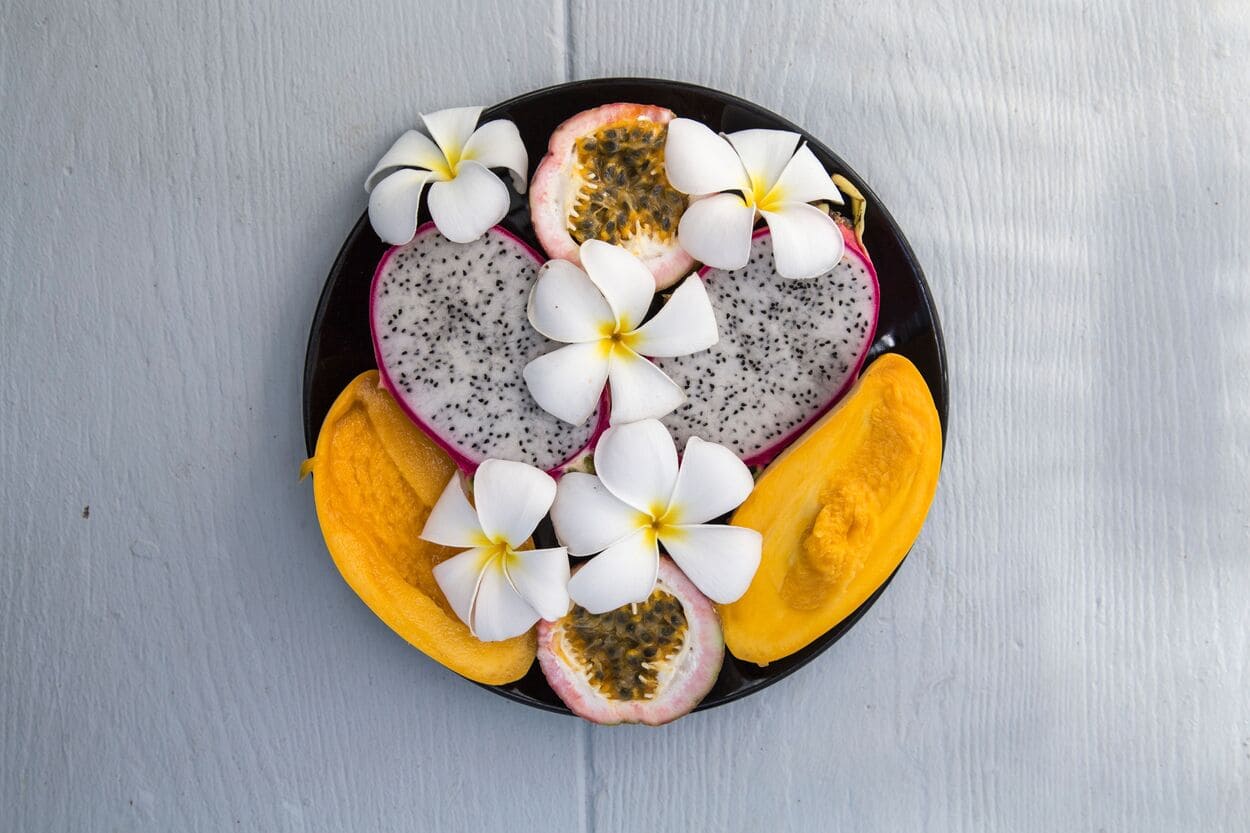
Mango is a low-acid, high-sugar fruit with a soft, almost creamy texture once ripe — closer in mouthfeel to a fat than most fruits get, which may help explain why it works so well as a foil for capsaicin even without literal fat content. Its sweetness is direct rather than sharp, which makes it a natural counterweight to fierier chilies. Mango habanero has become one of the most widely used swicy flavor combinations in recent years, showing up in wing sauces, salsas, and glazes, in large part because mango's mellow sweetness lets habanero's fruity, floral heat come through without the dish reading as simply "hot."
Why passion fruit works
Passion fruit brings a different profile to the same job: intense aromatics, real acidity, and a tart-sweet balance rather than mango's straightforward sugariness. Where mango softens heat by leaning into pure sweetness, passion fruit tends to add complexity alongside the sweetness — its perfumed, slightly musky aroma and pronounced tartness give a dish more going on, which is part of why chefs and food-trend writers describe fruit-forward heat as "layered" rather than one-note. It pairs particularly well with serrano and habanero in glazes, cocktails, and sauces, where its acidity and aromatics keep a dish from tasting like sugar syrup with chili stirred in.
How the trend actually shows up in food
Coverage of the swicy and fricy trends points to a fairly consistent set of applications:
- Sauces and glazes. Mango or passion fruit puree reduced with chili — habanero, serrano, or chipotle are common pairings — used on wings, grilled chicken, or shrimp.
- Salsas and condiments. Diced mango or passion fruit pulp mixed with fresh chili, lime, and herbs, served alongside grilled meats or fish tacos.
- Drinks. Spicy mango or passion fruit margaritas and other cocktails, along with chili-rimmed or chili-dusted fruit drinks, have been called out repeatedly in trend coverage as a fast-growing category.
- Chamoy-style condiments. Chamoy, a Mexican condiment built from pickled fruit, chili, and lime, has surged in popularity for drizzling over fresh fruit and candy — a direct ancestor of the mango/passion fruit swicy pairing rather than a new invention.
- Desserts. Chili-infused caramel or fruit sauces over ice cream, and passion fruit curd or mango puree paired with a mild chili note, show up increasingly on dessert menus looking for a "complex heat" angle rather than straightforward sweetness.
Industry trend reporting — including McCormick's flavor forecasting and coverage in Food Technology magazine — has specifically named mango, guava, dragon fruit, pineapple, and yuzu as the tropical and citrus fruits driving demand for what one industry marketer called "fruit-forward heat," typically paired with jalapeño, habanero, or chipotle. It's worth treating those specific growth figures and consumer-percentage statistics as trend-industry reporting rather than independently verified science — they describe what marketers and menu trackers are observing, not a controlled study, though the underlying pattern (tropical fruit increasingly paired with chili across menus and products) is corroborated across multiple independent outlets.
Getting the balance right
A few practical principles come out of both the trend coverage and the underlying science of how sweetness interacts with heat:
- Let the fruit's natural sweetness do the work rather than stacking sugar on top of it. Since the "fricy" shift is specifically a move away from refined sugar, adding a puree or fresh fruit alongside a moderate amount of chili tends to read as more balanced than a very sweet syrup with chili added as an afterthought.
- Match the chili to the fruit's character. Habanero's fruity, floral notes complement mango's straightforward sweetness, while passion fruit's acidity and aromatics can stand up to sharper, greener heat from serrano or jalapeño.
- Add fruit-based sweetness toward the end of cooking when possible. Because heat perception is partly about timing and contrast, a fresh or lightly cooked fruit element — a salsa, a finishing puree, a glaze brushed on late — tends to preserve more of the fruit's brightness than one cooked down for a long time.
- Don't expect fruit to eliminate heat, only to reframe it. The cross-modal sweetness effect measurably dulls perceived spiciness, but it doesn't remove capsaicin's effect on genuinely hot peppers — a passion fruit habanero sauce is still a habanero sauce.
The appeal of mango and passion fruit as heat balancers isn't just current food-trend marketing — it rests on a real, if partial, sensory mechanism: sweetness measurably competes with capsaicin's signal to the brain, softening how hot a dish reads even though it doesn't change how much capsaicin is actually present. Mango and passion fruit each do that job differently — mango through direct, mellow sweetness, passion fruit through a tarter, more aromatic complexity — which is largely why both have become the go-to tropical fruits for a trend that's really just a more deliberate, fruit-forward version of an old culinary instinct.